
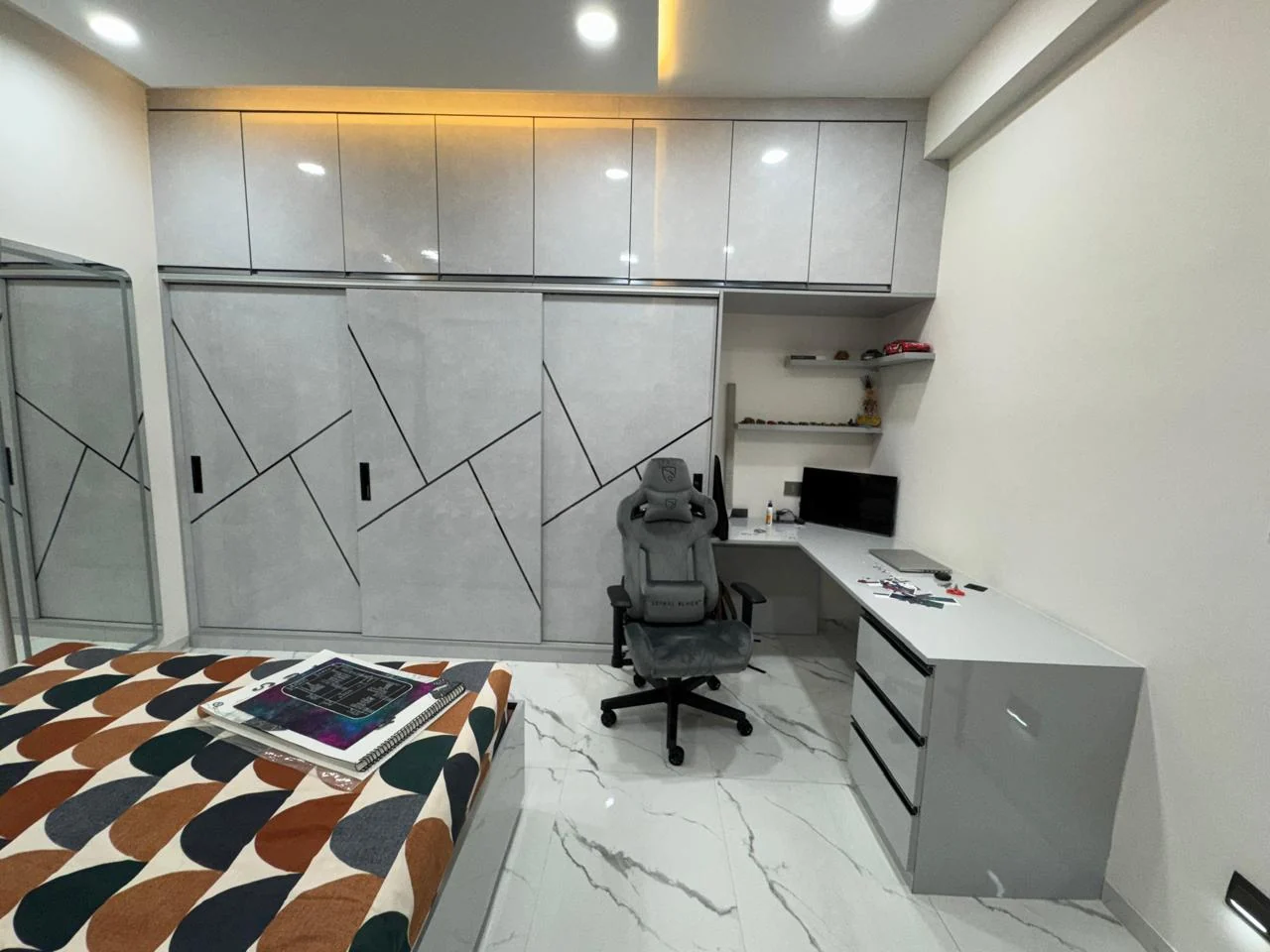
Clients often arrive with what they believe is a conflict: they want the home to look uncluttered, and they need somewhere to put a great many things. These are not actually opposed. What creates the conflict is deciding storage last.
Storage designed late always shows
When cupboards are added after the aesthetic is settled, they arrive as objects — a unit here, a cabinet there — and the room reads as furnished rather than designed. When storage is planned first, it becomes architecture: a full-height plane, a wall, a volume that the room is organised around.
The practical rule is to establish the storage volume before the finishes. Count what needs to be stored, convert that into linear metres of cabinetry, and find the walls that can carry it.
Push it to the perimeter
Rooms feel generous in proportion to how much clear floor they have in the middle. Consolidating wardrobes, dressing, storage and even a work surface along one or two walls leaves the centre of the room empty — and an empty centre is what makes a space feel calm regardless of its actual size.
Make it disappear
Several techniques reliably make large volumes of storage visually quiet:
- Take joinery to full height, so it reads as a wall rather than furniture.
- Use one finish across the whole run, without contrast bands or breaks.
- Use handleless profiles or slim recessed pulls instead of hardware.
- Match the shutter finish to the adjacent wall where you want it to vanish, or contrast it deliberately where you want it to feature — but choose.
Allow a small proportion to be open
Fully closed storage across an entire wall can feel oppressive. Interrupting it with a small amount of open or glazed shelving — perhaps one part in five — gives the eye relief and gives the household somewhere for the things they reach for daily.
The discipline is that open shelving must stay curated. Its function is visual, not practical.
Functionality is a planning question
Nearly everything that makes a home work well is decided on the plan, not in the finish selection:
- Where you set down shopping bags on arriving home.
- Whether the bin is inside the cabinet or beside it.
- Whether the wardrobe door can open fully with the bed in place.
- Whether there is a socket where you actually charge your phone.
None of these cost anything at the drawing stage. All of them are expensive or impossible to fix afterwards.
Beauty is what is left
When storage is resolved architecturally and function is resolved on the plan, the aesthetic decisions become straightforward — because there is nothing left that has to be worked around.