
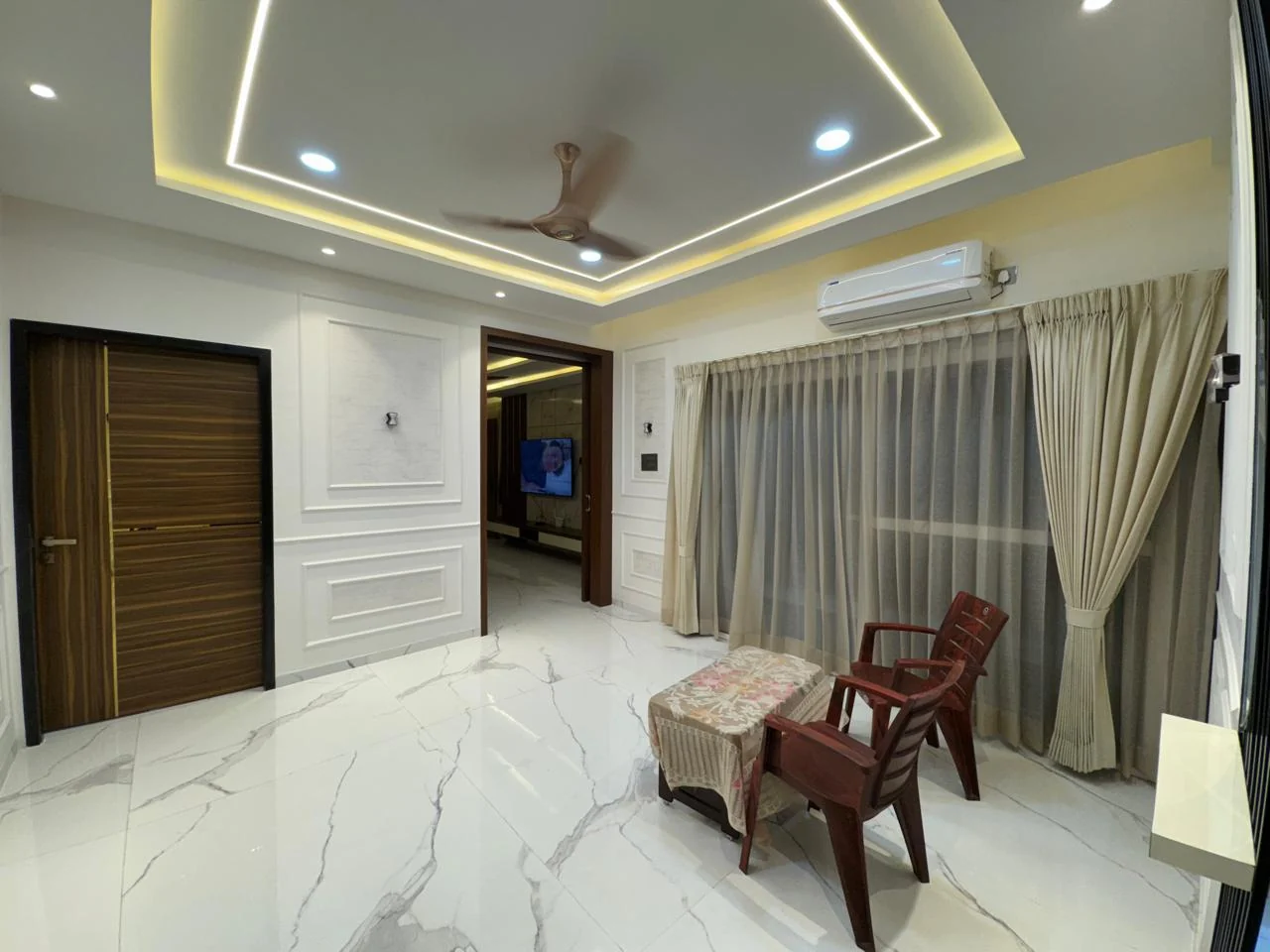
Most living rooms that feel expensive are not expensive because of what is in them. They feel that way because a small number of decisions were made correctly and then nothing else was allowed to interfere.
Start with the seating plan, not the feature wall
The most common mistake is choosing a feature wall treatment before deciding where people sit. Work the other way round. Establish how many people the room must seat on an ordinary evening and how many at a gathering, then place the seating, then decide which wall the eye lands on.
A sofa pushed flat against every wall makes a room feel like a waiting area. Pulling the seating group inward, even by a few inches, and letting a rug define its edges will do more for the room than any amount of panelling.
Get the three dimensions right
Three measurements account for most of the difference between a room that reads as considered and one that does not.
- Curtain height. Mount the track close to the ceiling, not to the top of the window. The window will appear taller and the wall calmer.
- Rug size. The rug should sit under the front legs of every piece of seating at minimum. A rug floating in the middle of a furniture group makes the group look accidental.
- Art height. Hang so the centre of the piece is near seated eye level in a living room, not standing gallery height.
Light the walls, not the floor
A grid of ceiling downlights aimed at the floor produces a flat, unflattering room. Aim light at vertical surfaces instead — wall washers, an adjustable track directed at the art wall, concealed cove light in the ceiling perimeter. The room is then lit by reflected light, which is softer and considerably more forgiving.
Keep the colour temperature consistent. Mixing a cool white downlight with a warm cove light is one of the quickest ways to make a well-built room look cheap. Warm white, around 2700K to 3000K, suits most Indian living rooms.
Restrict the palette
Three materials is usually enough: one timber, one stone or plaster, one metal. A fourth introduces a decision the room has to justify. If you want variety, vary the treatment rather than the material — the same timber in a fluted panel, a flat veneer and a fretwork screen reads as one idea developed, not three ideas competing.
Leave something empty
Every room needs a plane that is doing nothing. An empty stretch of wall, a clear length of floor, a console with two objects instead of nine. Restraint is the part of luxury that costs nothing and is the first thing sacrificed.
What to spend on
If the budget is finite, spend it in this order: lighting, seating, joinery, then decoration. Lighting changes how everything else looks. Decoration changes only itself.