
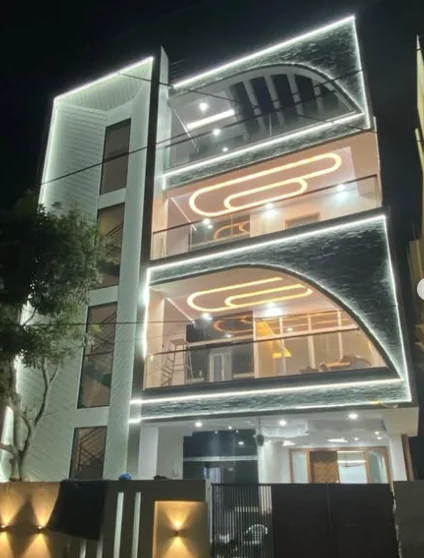
Lighting is the highest-leverage decision in an interior and the one most often reduced to "how many downlights". A well-lit room uses three layers, and each has a distinct job.
Ambient — the base level
Ambient light establishes the general brightness of the room. It should be soft and as indirect as you can manage: concealed cove lighting washing the ceiling, wall washers, or widely spaced downlights.
The mistake is treating ambient light as the whole scheme. A dense grid of downlights produces even, flat, shadowless illumination — technically bright, visually dead, and unkind to faces.
Task — light where work happens
Task light is aimed at a specific surface at a specific brightness:
- Under wall cabinets, along the kitchen counter.
- Over a desk or study niche.
- Beside the bed, at a height that suits reading while seated.
- Around a dressing mirror, from both sides rather than overhead.
The test is simple: if your own body casts a shadow on the surface you are working at, the task lighting is wrong.
Accent — light that creates interest
Accent light is what gives a room depth. Directed at art, a textured wall, a niche or a plant, at roughly three times the surrounding brightness. This layer is optional in a functional sense and essential in an emotional one — it is the difference between a room that is lit and a room that has atmosphere.
Getting the specification right
Colour temperature. Keep it consistent. 2700K–3000K for living areas and bedrooms; up to 4000K is acceptable in kitchens and workspaces. Mixing temperatures within a single sightline looks like a mistake, because it is one.
Colour rendering. Look for CRI above 90 wherever material and skin tone matter. Low-CRI fittings make timber look grey and food look unappetising.
Dimming. Put ambient and accent layers on dimmers. The same room needs very different levels at 8am and 10pm, and a dimmer is far cheaper than a second lighting scheme.
Conceal the source. Wherever possible, you should see the light, not the fitting. This single principle accounts for most of the difference between architectural lighting and decoration.
A simple starting scheme for a living room
- Concealed cove around the ceiling perimeter, dimmable — ambient.
- Two or three adjustable spots aimed at the art or feature wall — accent.
- A floor lamp beside the seating — task.
- Downlights only where genuinely needed, not on a uniform grid.